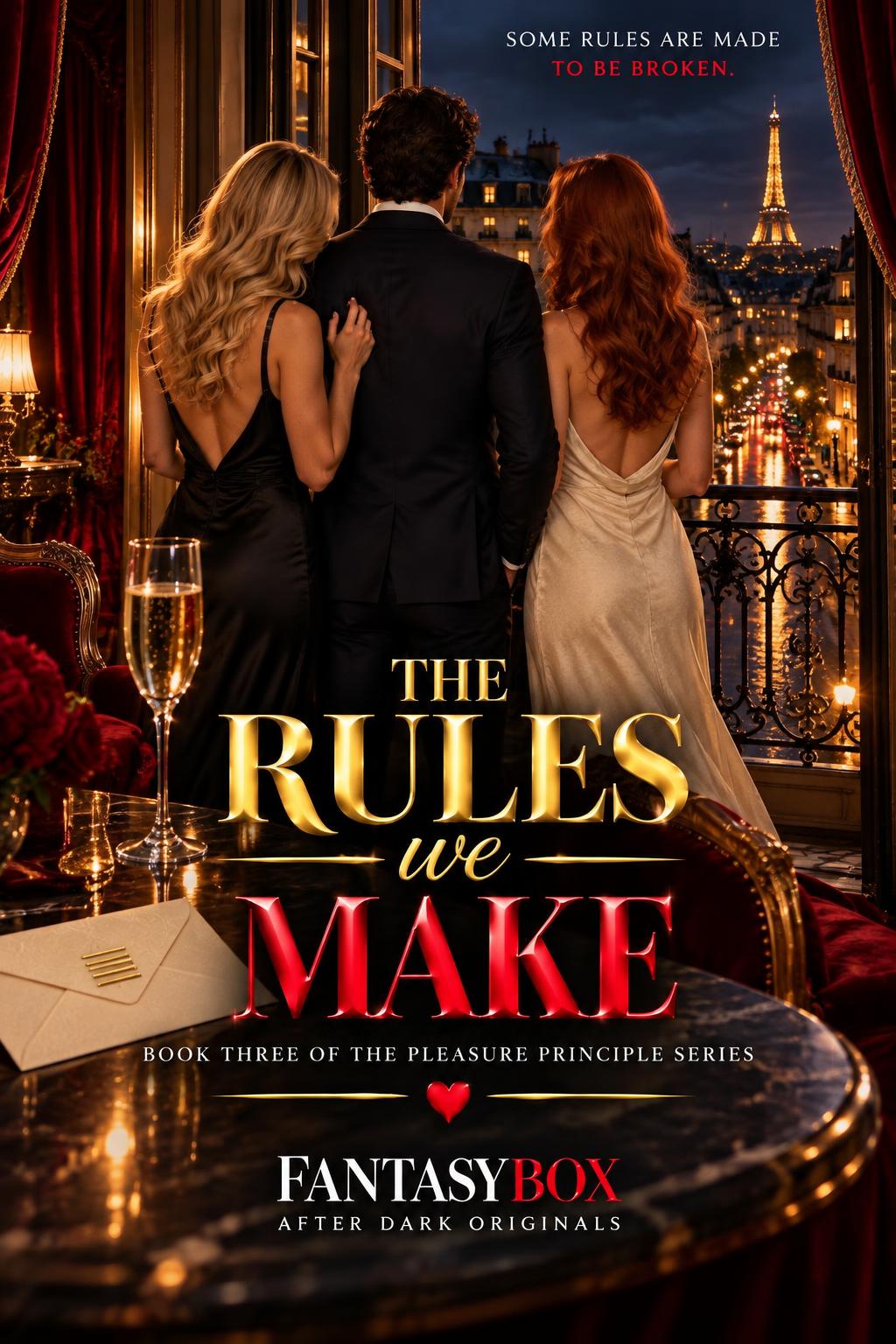
The Rules We Make
The Pleasure Principle — Book Three
Some rules are made to be broken.
Paris is rinsed in early morning rain when Max finally says the name: Julian Mercer. Eleven years ago they were partners in a grand old building that now houses La Maison des Sept Portes — until records went missing and Max walked away with a settlement and a silence.
Now a formal invitation has arrived, embossed with seven narrow lines, and a flattering commission in Edinburgh is asking for Charlotte Bennett by name. A shared address isn't a connection. But Charlotte is done being told there is nothing to worry about.
From the Crimson Salon to the mirror game and a room without light, Charlotte, Max and Alessia learn that trust isn't a rule you inherit — it's one you write together, and rewrite whenever someone you love needs it.
Glamorous, tense and tender, Book Three of The Pleasure Principle is about the rules worth keeping, the ones worth breaking, and the door Charlotte finally opens for herself.
- Format: PDF digital download (around 250 pages)
- Reads on any phone, tablet, computer or e-reader
- Secure card payment — nothing physical is posted
£3.99 — PDF digital download
- Apple Pay
- Google Pay
- Card
- PayPal
Or pay with PayPal
Secure checkout. Your download link appears right here after payment and is emailed to you. Digital content starts when you download, which ends the usual 14-day cancellation period.
Instant digital download · Available worldwide
Read a free chapterFree sample
Chapter One: The Beginning of the Truth
“Julian Mercer,” Max said.
The name landed between the three of them with the sharp finality of a verdict. Beyond the windows, Paris was rinsed in early morning rain. Charlotte had been standing by the dining table for so long that her tea had gone cold. Alessia sat on the arm of the sofa, one heel hooked against its leg, watching Max with an expression that had moved past patience.
“That’s a name,” Charlotte said. “Not a beginning.”
Max looked at the envelope on the table. It had arrived with the previous evening’s post, a formal invitation to a private house in Paris, embossed with seven narrow lines. On the back someone had written a date, a time and nothing else.
“Eleven years ago, Julian and I financed a restoration,” he said. “An old property. The one that now houses La Maison des Sept Portes. We weren’t running a club. We were investors in the building, and the charity exhibition held there was meant to raise money for the restoration.”
“Meant to,” Alessia repeated.
“Julian had a second set of contractor credentials made. At least that’s what I believe happened. He used the service access to the east wing on a night when no one was supposed to be there. Some collection records went missing. An insurer asked questions. He said it was a misunderstanding.”
“Was it?” Charlotte asked.
“I never found enough to prove otherwise. I ended the partnership. The lawyers drew up a settlement and a confidentiality agreement.”
Charlotte stared at him. “You told us there was nothing from your old business life that could reach us.”
“I thought there wasn’t.”
“That isn’t the same thing.”
He accepted the correction without defending himself, which annoyed her almost as much as an argument would have. She wanted something solid to push against. Instead he looked tired, his usually immaculate shirt creased at one elbow, his dark hair still damp from a shower he’d taken without sleeping.
Alessia stood. “What exactly has brought Julian back into this? A piece of paper with a pretty symbol?”
“Not exactly.” Max opened his laptop and turned it towards them. A photograph showed a corridor with flaking plaster and a seven-line emblem above a narrow service door. “Inès sent Charlotte an enquiry about a travelling exhibition in Edinburgh. The underwriter insisted on Charlotte by name. The property contact on the paperwork matches an address once used by Julian’s serviced office.”
Charlotte studied the screen. She remembered the email arriving at an absurd hour, its flattering language about her Marseille work, the promise of creative freedom, the peculiar reluctance to identify the person funding it. At the time she’d thought the worst thing about the proposal was the phrase ‘immersive heritage journey’.
“A shared address isn’t a connection,” she said.
“No,” Max agreed. “It isn’t.”
“Then stop talking as though you’ve found him standing in the corridor.”
He closed the laptop. “You’re right.”
Alessia crossed to Charlotte and took the cold mug from her hand. “There are two separate things here. Your Hartwell House commission is real. Priya has arranged your Monday site visit in Edinburgh. This other exhibition is an offer from people who won’t properly identify themselves. We don’t confuse them just because they’re in the same city.”
Charlotte felt the relief of hearing someone say it plainly. “Thank you.”
“I am occasionally useful,” Alessia said. “Though apparently not when choosing men with complicated histories.”
Max’s mouth twitched. “I deserved that.”
“Not the entire catalogue,” Alessia replied. “Only the opening selection.”
Charlotte sat and opened her notebook. It was a habit from work: when the room became emotionally expensive, she made a list of what could be measured. She wrote HARTWELL — PRIYA — MONDAY on one page and EXHIBITION — INÈS — UNVERIFIED on the next. Under the second heading she copied the underwriter’s name and the contact address. Then she drew seven short lines in the margin.
The story continues in the full book.
More After Dark books
Prefer your night in a box?
Explore the FantasyBox mystery boxes